Music & Dance
Explore the rich musical heritage of the Rai people — the Sakela Sili dance, traditional instruments, folk songs, and their deep cultural significance.
Featured Answer
What is Rai Music and Dance?
Rai music and dance are central to the cultural identity of the Rai people of eastern Nepal. The most famous is the Sakela Sili, a circular dance performed during the Sakela festival where men and women hold hands and move in a circle to the beat of traditional instruments. The Damphu drum provides the heartbeat, the Bansuri flute carries the melody, and the Madal adds depth. These art forms celebrate nature, agriculture, and community unity.
Sakela Sili — Dance Steps
The Sakela Sili is the most important dance of the Rai people, performed in a circular formation. Here are the traditional steps:
Basic Stance (Tiyatar)
Dancers stand in a circle facing inward, feet shoulder-width apart. Arms are held loosely at sides. This is the foundational position from which all movements originate.
Hand Joined (Jutta Linu)
Dancers join hands with the people on either side, creating an unbroken circle. Hands are held at waist height. This symbolizes the unity and interconnectedness of the community.
Rhythmic Stamping (Tipti Linu)
All dancers begin stamping their feet in unison to the beat of the Damphu drum. The stamping creates a powerful, resonant sound that echoes through the gathering.
Swaying Movement (Helnu)
The circle sways from side to side in a wave-like motion. Dancers move together as one body, creating a visual representation of the wind moving through rice fields.
Forward March (Aghi Linu)
The circle begins to move slowly forward in a clockwise direction. Each step is taken in perfect synchronization with the drumbeat and the steps of fellow dancers.
Circular Rotation (Ghumnu Linu)
The entire circle rotates as one unit, maintaining the joined hands. The rotation represents the cycles of nature, seasons, and the eternal flow of time.
Raised Hands (Hat Linu Thapnu)
Dancers raise their joined hands above their heads while continuing to move in a circle. This upward movement symbolizes reaching toward the sky and honoring Paruhang.
Lowered Hands (Hat Linu Ubharnu)
Arms slowly lower back down to waist height while the dance continues. This movement represents humility and connection to Mother Earth (Sumnima).
Faster Rhythm (Chahedar Linu)
The tempo increases as the drummers play faster. Dancers' steps quicken, and the energy in the circle intensifies. This builds to the climax of the dance.
Final Unity (Karyakalap)
The dance concludes with all dancers raising their hands high and singing the traditional Sakela closing song. The circle tightens as the community comes together in the moment of completion.
Traditional Rai Instruments
The Rai people have a rich tradition of musical instruments, each with its own role in ceremonies, celebrations, and daily life:
Damphu
A circular frame drum with a skin head, played with the hands. The Damphu provides the foundational beat for Sakela dancing. Its deep, resonant sound carries through valleys and is said to call the spirits to join the celebration.
The heartbeat of Sakela — without the Damphu, there is no Sakela dance.
Bansuri (Flute)
A bamboo flute with six finger holes, producing a hauntingly sweet, breathy tone. The Bansuri is associated with Paruhang, the supreme sky god, who is said to have created the first flute to communicate his love to Sumnima, the earth goddess.
Divine instrument — the sound of Paruhang reaching for Sumnima.
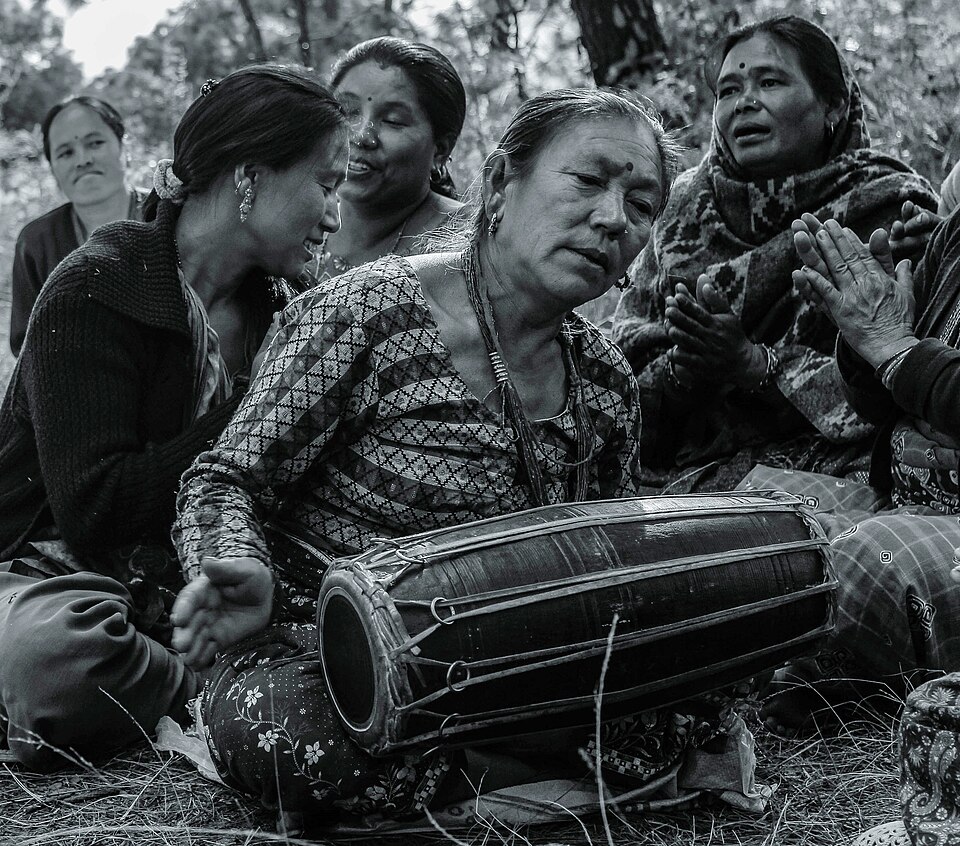
Madal
A double-headed hand drum with a barrel-shaped body. The Madal produces a deep, resonant tone on one head and a higher pitch on the other. It is played with both hands and is essential for folk songs and dance accompaniment.
The people's drum — found in every Rai household, played at all celebrations.
Jhyamta (Cymbals)
Small hand cymbals made of brass or bronze, producing a bright, ringing sound when struck together. Jhyamta players keep time and add melodic accents to the music.
Keeps the rhythm steady and signals changes in the dance pattern.
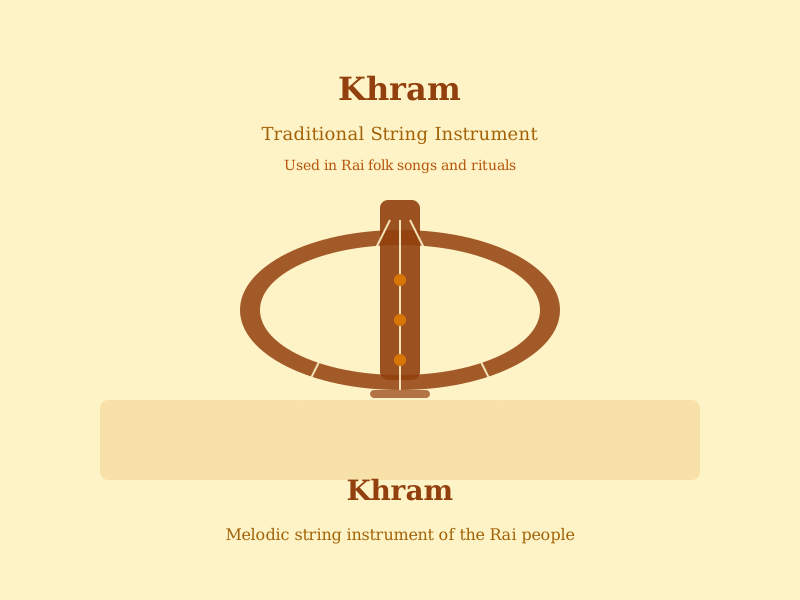
Khram
A traditional string instrument used in some Rai communities. The khram produces melodic sounds and is used in both ritual and social musical performances. It adds a unique dimension to Rai music with its distinctive string resonance.
Melodic string instrument — adds depth and emotion to folk songs.
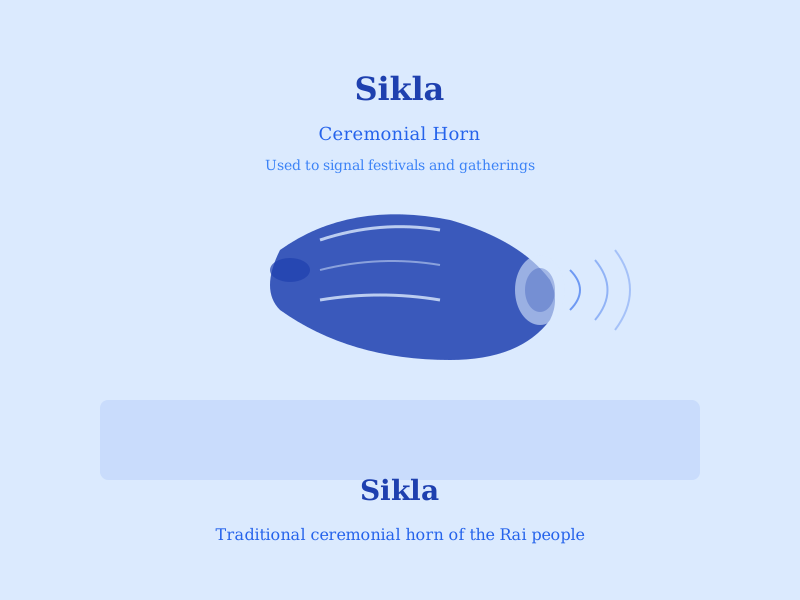
Sikla
Traditional horns made from animal horns or bamboo, used in certain ceremonial contexts and gatherings. The sikla produces a distinctive sound that can carry over long distances, making it ideal for signaling and ceremonial announcements.
Ceremonial horn — used to signal the start of festivals and gatherings.
Types of Rai Folk Songs
Rai folk songs serve different purposes in the community:
Sakela Git (Sakela Songs)
Traditional songs performed during the Sakela festival. These songs celebrate nature, agriculture, community, and the divine. They are sung in Rai languages and often call and response between the lead singer and the chorus.
Kharma Git (Dance Songs)
Upbeat, rhythmic songs accompanied by Damphu and Madal. These are the songs that make the community dance at gatherings, weddings, and celebrations. The lyrics often tell stories of love, daily life, and Rai heroes.
Seulo Git (Work Songs)
Songs sung during agricultural work — planting rice, harvesting millet, grinding grain. The rhythm helps synchronize group work and makes labor more enjoyable. These songs are passed down through generations.
Bhailo Git (Wedding Songs)
Special songs performed during weddings, expressing joy, blessings, and advice for the couple. Bhailo songs are often sung by women and include playful teasing of the groom and his family.
Soor Marso (Lamentations)
Mournful songs performed during funerals and times of sorrow. These songs express grief, honor the deceased, and comfort the bereaved. They are deeply emotional and culturally significant.
Lullabies (Palam Soor)
Gentle, soothing songs sung to infants and young children. Lullabies pass on cultural values, language, and love to the youngest generation. Each Rai subgroup has its own distinctive lullabies.
Dance Costumes & Adornments
Women's Sakela Attire
- • Pachhat: Wrapped skirt in vibrant red, orange, or gold
- • Cholo: Fitted blouse matching the pachhat
- • Khanggu: Traditional necklace made of coins or beads
- • Sirphul/Ful: Forehead ornament or fresh flowers in hair
- • Potay: Traditional waist chain with bells
- • Nose ring: Gold or silver, symbol of married status
Men's Sakela Attire
- • Dhoti: Wrapped trouser, often in white or cream
- • Kurta/Cholo: Traditional vest or tunic
- • Topi: Traditional headgear or turban
- • Khukuri: Traditional curved knife (ceremonial)
- • Mug: Traditional scarf or cloth belt
- • Khanggu: Traditional necklace for ceremonies
Cultural Significance of Rai Music & Dance
Music and dance are not mere entertainment in Rai culture — they are the living expression of community identity, spiritual connection, and ancestral memory. The Sakela Sili dance, performed in a circular formation with joined hands, symbolizes:
- Unity: The circle has no beginning or end — representing the eternal unity of the Rai community
- Connection to Nature: The dance movements mimic natural phenomena — wind through fields, flowing water, the cycle of seasons
- Spiritual Communication: The music and movement create a bridge between the physical world and the spiritual realm
- Ancestral Connection: The steps and songs have been passed down for generations, connecting living Rai to their forebears
- Cultural Preservation: Each performance is an act of cultural resistance and preservation in the face of modernization
Today, Rai communities worldwide — from eastern Nepal to Sikkim, Darjeeling, Bhutan, the UK, Malaysia, and beyond — continue to perform the Sakela Sili at festivals, weddings, and cultural events. The dance has become a symbol of Rai identity in the diaspora and a powerful statement of indigenous cultural pride.